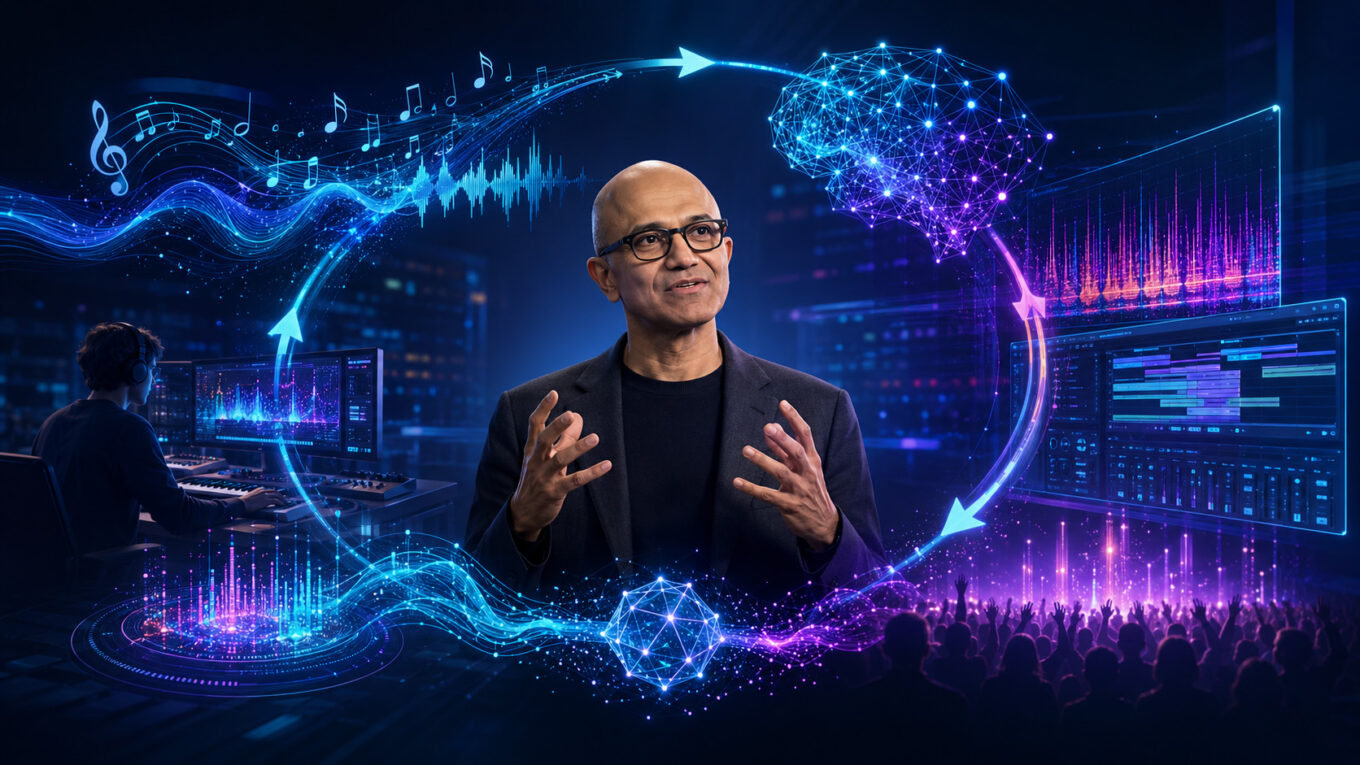
I came across a post from Microsoft CEO Satya Nadella on X, where he talks about how the next generation of AI companies will not be built only by using models, but by creating learning loops around them. The idea is simple but extremely important: the real advantage comes when every user interaction, every output, and every result feeds back into the system and makes the product smarter over time. That is what turns a product from a simple AI wrapper into a compounding engine.
What Microsoft CEO Satya Nadella is describing here is basically the exact moat layer we are building with RockAgent. If we turn every piece of music created by every user into a dataset, then put those outputs through paid and organic testing loops, analyze which sets perform better, and keep feeding those learnings back into our own engine, that is exactly the learning loop he is talking about. It is just the music version of it.
And the good news is this: Suno has already started moving in this direction. They recently introduced a (pre) fine-tuning feature that enables a more personalized engine experience. Right now, it is only available to end users, but it is already possible to access similar customization through third-party intermediaries in a B2B-like setup, at least in the sense of building a customized experience for a user. Official API support is also expected to come.
So why is it not here yet? Because Suno is still in the middle of lawsuits with the biggest labels and music companies in the world. And for a company like Suno, which is clearly on a decacorn path, the natural buyers of its B2B layer are those exact same giants. Once that legal tension is resolved, the biggest blocker in front of the B2B layer disappears. That is probably why they are still holding back.
My read is simple: Suno will eventually open up fine-tuning, and they will package it through B2B. It will look very similar to how OpenAI opened the API layer first, then built the fine-tuning layer on top of that distribution. Companies with proprietary data will be able to train and improve their own engines. And when that moment comes, we will already be ahead, because we will have started collecting user data, testing outputs, analyzing performance, and feeding those learnings back into our system long before the rest of the market catches up.
The industry may still think the valuable part is generating the music. It is not. The real value is in collecting the data, understanding what works, and building the learning loop around it. That is the moat. And that is the key to building a billion-dollar company.