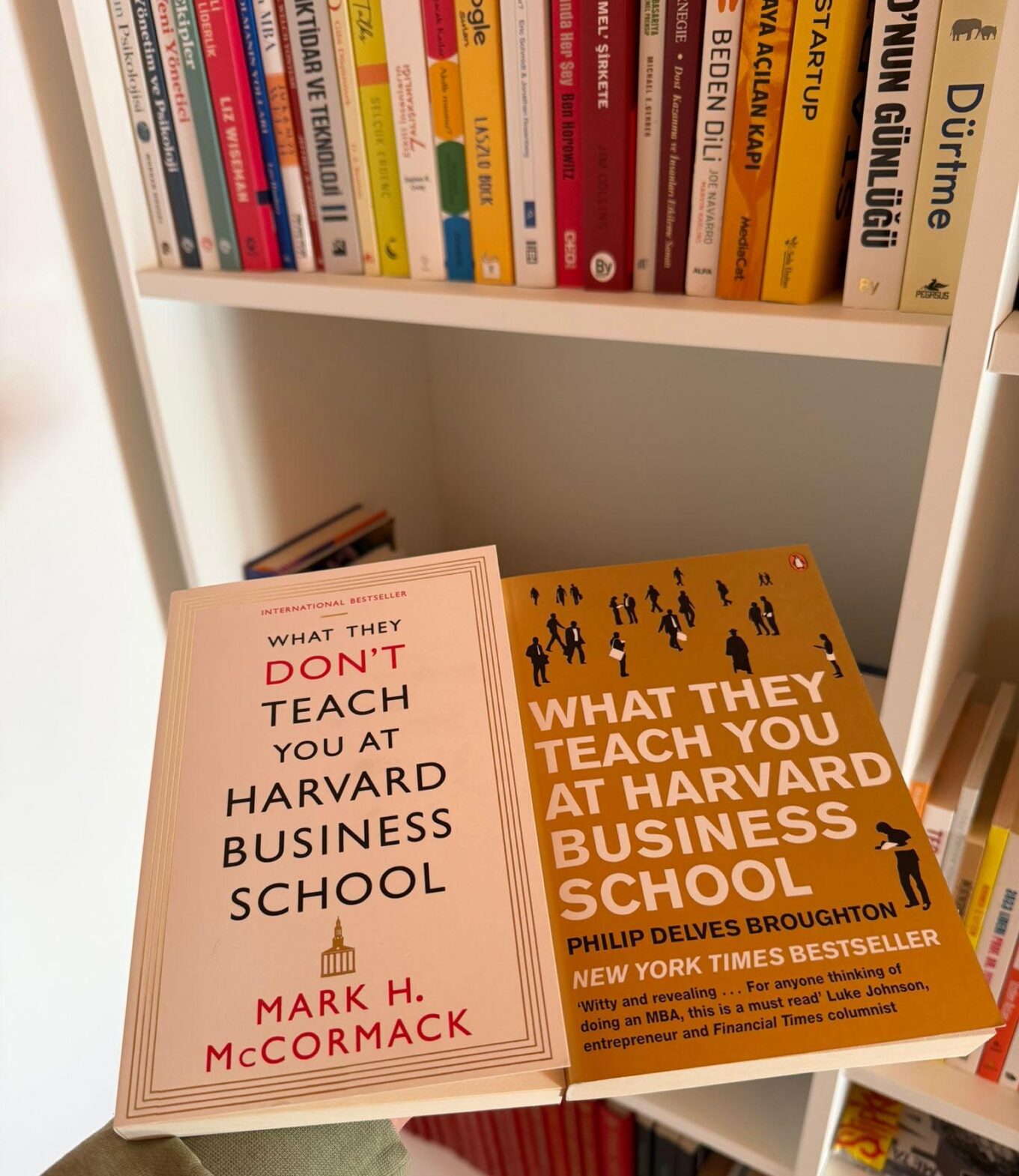
On my last trip to the UK, I came across these two books while browsing a bookstore. I want to write a few thoughts about the underlying philosophy of these books, which you could almost call cross-readings of one another, even though they sit on two different foundations. Because the authors are different, I picked them up with the expectation that instead of being a series by the same writer, they would feel like two authors facing off and trying to refute each other’s theses; but it turned out not to be the case at all.
When we say Harvard Business, of course what comes to mind immediately is “top-tier” education. But both of these books made me feel that the whole thing is not only about “education,” but about “managing human relationships” and setting the right frame.
The “What They Teach You…” side is essentially an observational book in which the author recounts his two years at Harvard through the eyes of a journalist. One particular case discussed in the entrepreneurship classes caught my attention: an entrepreneur goes in front of an investor and gets sent back with a very harsh rejection. At that moment, the entrepreneur had an expectation along the lines of “at least respect my effort and congratulate me,” but for the investor that expectation was completely hollow. The lesson to be drawn here is that no one will care about your idea or the product you’ve built unless you offer something that pokes at their own self-interest. At that point, what you need to do is not get angry at the other side or react emotionally, but knock on their door again with a new equation that aligns with their interests.
On the “What They Don’t Teach You…” side, the narrative is simpler in terms of readability, moving forward in a more list-like structure. The main idea of the book is built around exploring how important human relationships are through different scenarios. For me, the most striking part was the section about delegation. It emphasized that a manager shouldn’t be trying to carry all the weight alone, but should instead develop the ability to position people in the right roles.
If you’ve read this far, you’ve probably noticed the following: even though the two books are presented with titles that sound like antitheses of each other, indirectly they both converge on the same point: people and human relationships. At this point, my personal takeaway is that the quality at Harvard Business may stem from these three things: understanding human relationships, building the right ones, and being able to run your work on top of those relationships.
It would have been nice to get this idea confirmed by a Harvard graduate—or to hear why it isn’t actually the case.
By the way, before I wrap up, let me share this little story: I was in the hotel lobby, leafing through the books. A young guy came up to me and said, “I’m building an app, would you like to take a look?” I didn’t quite understand what he meant in that moment and hesitated for a bit. Then, in a timid tone, he said, “Sorry for bothering you,” and walked away. I think the books were actually acting as a networking magnet at that moment, but I misread the signal. Maybe the kid really did have a million-dollar app idea and that opportunity slipped away because of my confusion. Who knows… =D